

The winning combination
What is Rheoderm® HMC ?
Rheoderm® HMC is a collagen peptide and hyaluronic acid supplement designed to support skin hydration, improve plumpness and firmness, and help reduce the appearance of wrinkles.
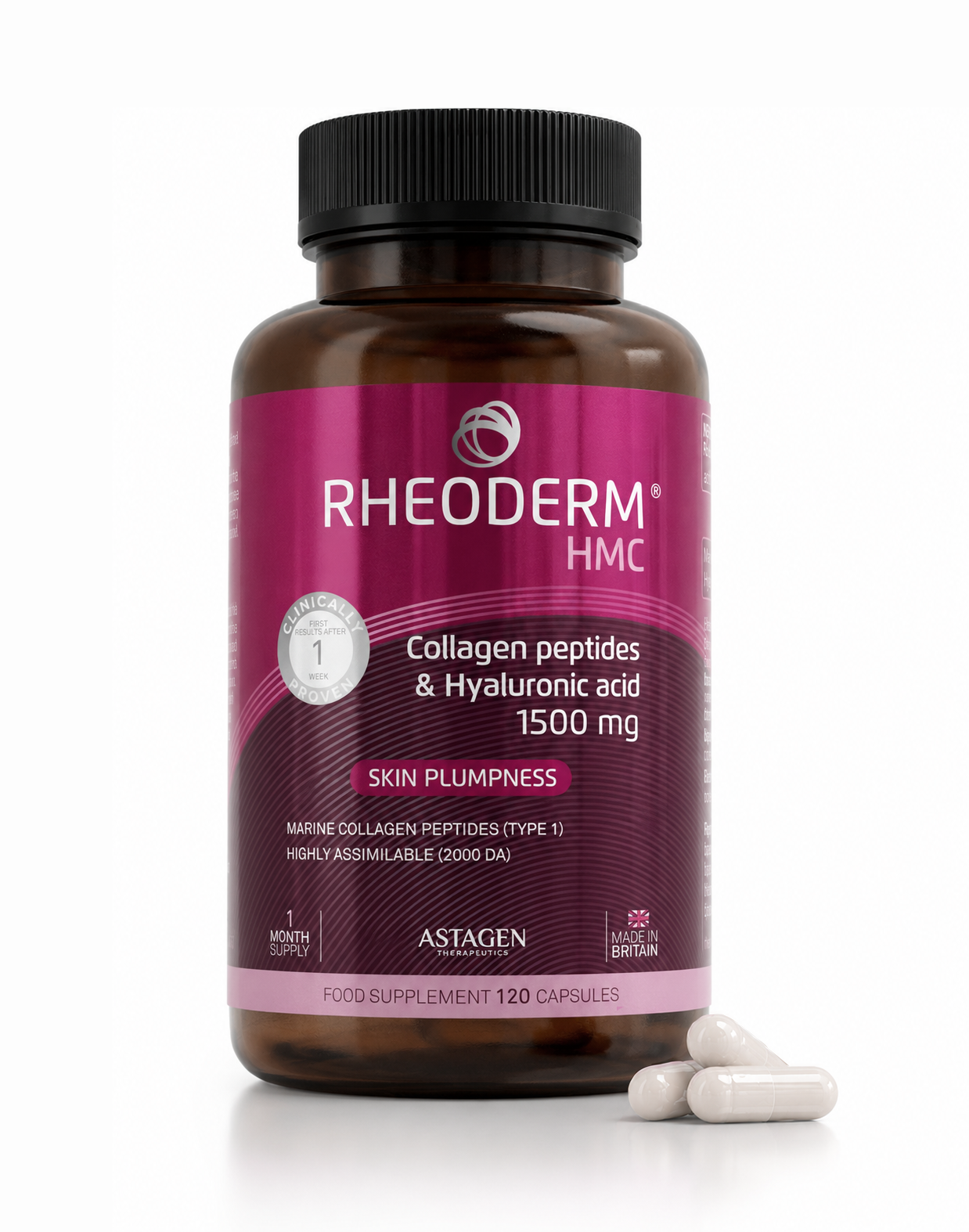
Rheoderm® HMC is composed of hydrolyzed marine collagen type I with a low molecular weight (2000 Da) for enhanced absorption, and pharmaceutical-grade hyaluronic acid obtained through biofermentation,
What is hyaluronic acid ?
An essential molecule whose quantity decreases with age
Hyaluronic acid (HA), a major component of the skin, is fundamental to retain water and maintain healthy skin tone, elasticity, and a smooth, youthful appearance (1).
However, aging and extrinsic stimuli such as solar ultraviolet radiation, smoking, and air pollutants gradually reduces the amount of HA in the skin (2-5).
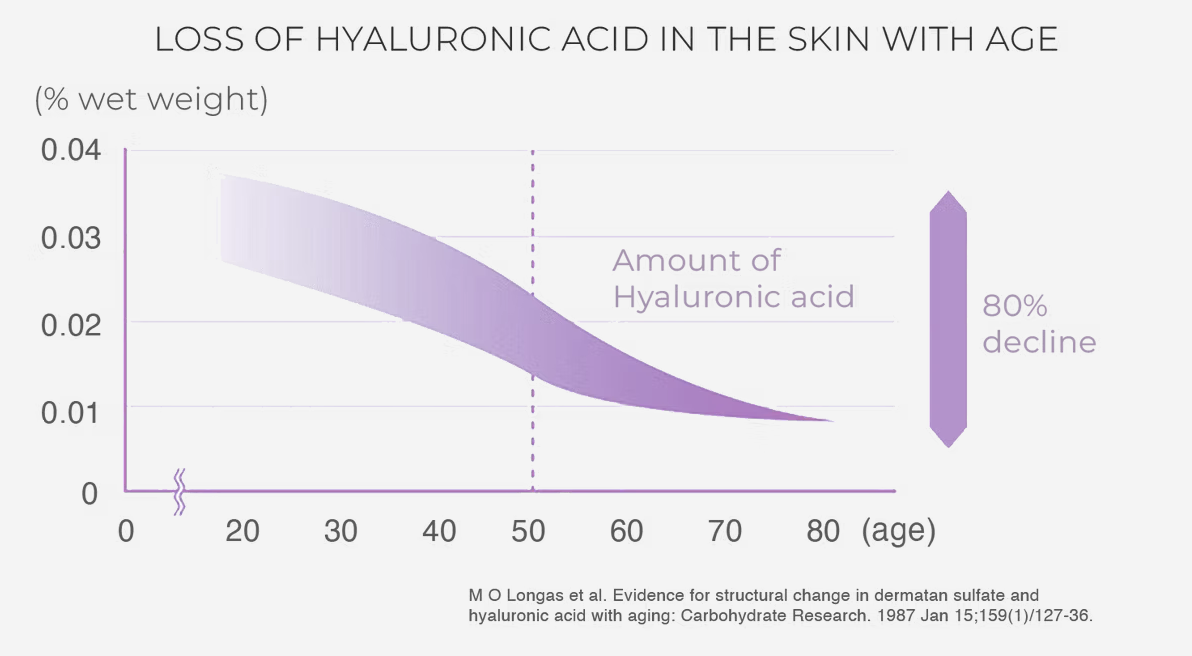
The skin loses elasticity and firmness, becomes thinner and dry, and fine lines appear on its surface. Therefore, correcting this loss of HA is an essential component of an anti-aging strategy.
A large molecule whose skin penetration is problematic
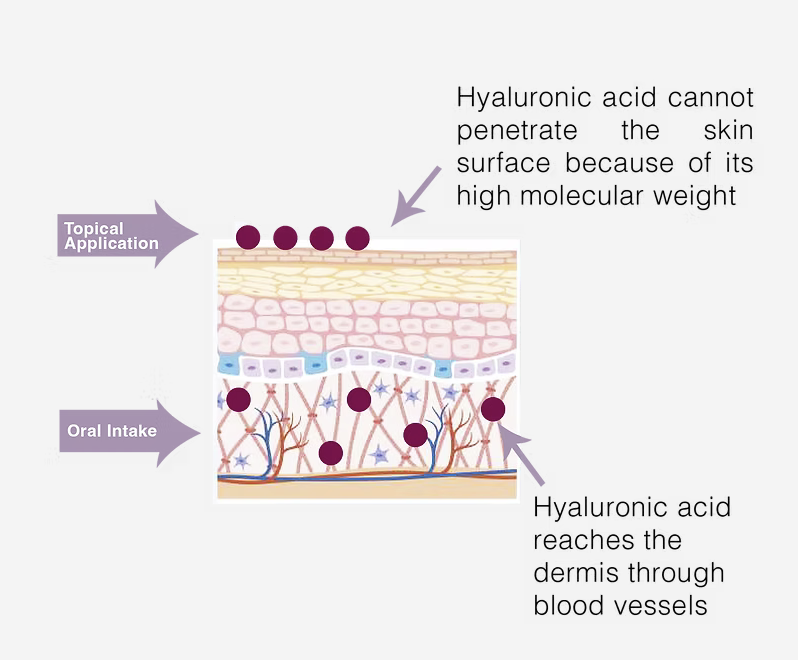
As the molecular weight of HA is relatively high, its penetration in the skin is very problematic when topically applied, and HA-based creams, lotions and serums will only moisturize the superficial layers of the skin. On the contrary, when orally administered, 90% of the ingested HA is absorbed into the body and migrate into connective tissues, such as skin (6-8). HA will then increase water in the skin and stimulates collagen, HA and proteoglycan synthesis as demonstrated in several clinical studies (9-13).
As a result, HA will provide a durable and deep skin hydration with a plumping effect.
Why collagen peptide supplementation ?
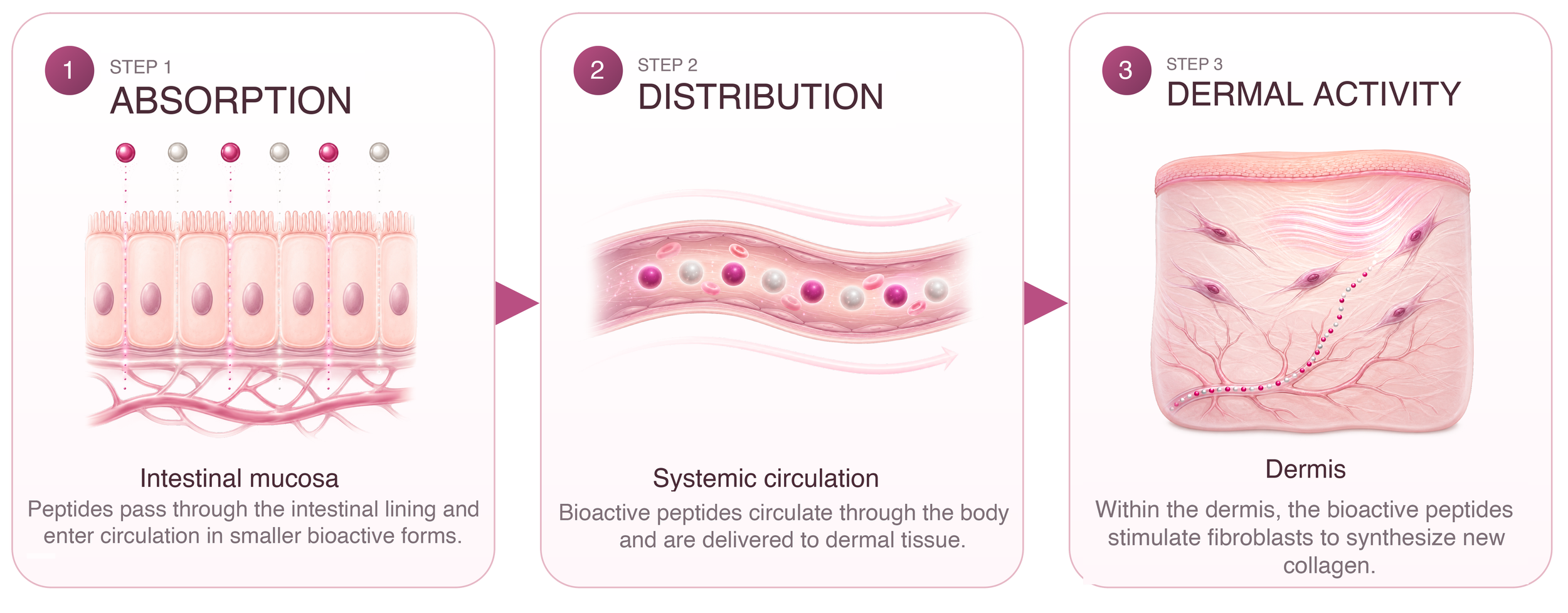
From your mid-20s, the body's natural collagen production begins to decline. This gradual loss shows up as fine lines, dullness, brittle nails and thinning hair. Supplementing with collagen peptides will stimulate your body's own collagen synthesis, supporting smoother, plumper skin and helping to strengthen hair and nails.
Marine collagen is a form of collagen protein derived from fish skin. It's rich in Type I collagen – the collagen type most abundant in our skin. Hydrolyzed into small peptides (2000 Da) for maximum absorption, it replenishes declining collagen stores and support skin structure, firmness and elasticity.
Our marine collagen peptides are clinically studied to help reduce wrinkles, improve skin elasticity and strengthen hair and nails.
-
1. Laurent TC, Fraser JR. Hyaluronan.‟FASEB J.‟1992;6:2397–2404. 2. Simpson RM, Meran S, Thomas D, Stephens P, Bowen T, Steadman R, Phillips A. Age-related changes in pericellular hyaluronan organization leads to impaired dermal fibroblast to myofibroblast differentiation. Am J Pathol. 2009;175(5):1915–1928. 3. Holmes MW, Bayliss MT, Muir H. Hyaluronic acid in human articular cartilage. Agerelated changes in content and size Biochem J.‟1988;250(2):435–441. 4. Uitto J. Understanding premature skin aging. N Engl J Med. 1997;337(20):1463–1465. 5. M O Longas, C S Russell, X Y He. Evidence for structural changes in dermatan sulfate and hyaluronic acid with aging. Carbohydr Res. 1987 Jan 15;159(1):127-36. 6. Sato T. Hyaluronic acid. JSMUFF. 2005;2(6):323–328. (in Japanese) 7. Balogh L, Polyak A, Mathe D, Kiraly R, Thuroczy J, Terez M, Janoki G, Ting Y, Bucci LR, Schauss AG. Absorption, uptake and tissue affinity of high-molecular weight hyaluronan after oral administration in rats and dogs. J Agric Food Chem.‟2008;56(22):10582–10593. 8. Laznicek M., Laznickova A., Cozikova D., Velebny V. Preclinical pharmacokinetics of radiolabelled hyaluronan. Pharmacological Reports. 2012;64(2):428–437. doi: 10.1016/S1734-1140(12)70784-3. 9. Kajimoto O, Odanaka W, Sakamoto W, Yoshida K, Takahashi T. Clinical effect of hyaluronic acid diet for Dry skin - objective evaluation with microscopic skin surface analyzer - J New Rem & Clin. 2001;50(5):548–560. (in Japanese) 10. Sato T, Sakamoto W, Odanaka W, Yoshida K, Urushibata O. Clinical effects of hyaluronic acid diet for Dry and rough skin. Aesthe Derma. 2002;12:109–120. (in Japanese) 11. Sato T, Yoshida T, Kanemitsu T, Yoshida K, Hasegawa M, Urushibata O. Clinical effects of hyaluronic acid diet for moisture content of dry skin. Aesthe Derma. 2007;17:33–39. (in Japanese) 12. Yoshida T, Kanemitsu T, Narabe O, Tobita M. Improvement of dry skin by a food containing hyaluronic acids derived from microbial fermentation. J New Rem & Clin. 2009;58(8):143–155. (in Japanese) 13. Terashita T, Shirasaka N, Kusuda M, Wakayama S. Chemical composition of lowmolecular weight hyaluronic acid from (chicken) and maintaining the moisture effect of ski by a clinical test. Memoirs of the Faculty of Agri of Kinki University. 2011;44:1–8. (in Japanese) 14.Zhu XH, et al. In vivo NAD assay revels the intracellular NAD contents and redox state in healthy human brain and their age dependences. Proc. Natl. Acad. Sci. 2015; 112:2876–2881 (2):CD003328. 15.Poljsak B. NAMPT-Mediated NAD biosynthesis as the internal timing mechanism: in NAD+ World, time Is running in its own way. Rejuvenation Res. 2018. June;21(3):210-224 16. Dickinson DA, Moellering DR, Iles KE, et al. Cytoprotection against oxidative stress and the regulation of glutathione synthesis. Biol Chem. 2003;384(4):527-537.