

Boost your NAD+ levels
What is Rheoderm® NMN ?
Rheoderm® NMN is a nicotinamide mononucleotide and hyaluronic acid supplement designed to boost NAD+ levels and support cellular repair and protection, helping reduce the signs of skin aging.
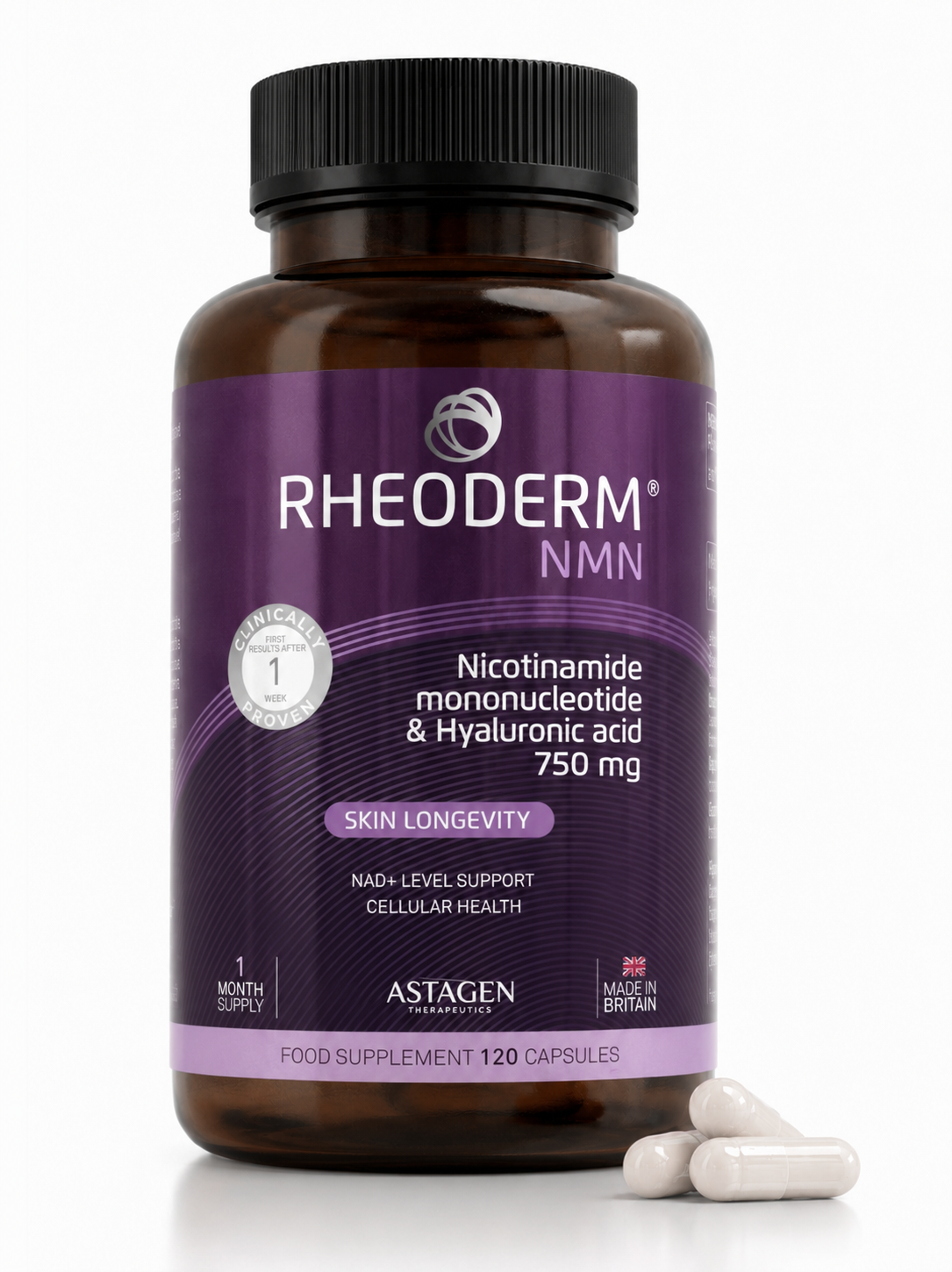
Rheoderm® NMN is composed of pharmaceutical-grade nicotinamide mononucleotide and hyaluronic acid obtained through biofermentation.
What is hyaluronic acid ?
An essential molecule whose quantity decreases with age
Hyaluronic acid (HA), a major component of the skin, is fundamental to retain water and maintain healthy skin tone, elasticity, and a smooth, youthful appearance (1).
However, aging and extrinsic stimuli such as solar ultraviolet radiation, smoking, and air pollutants gradually reduces the amount of HA in the skin (2-5).
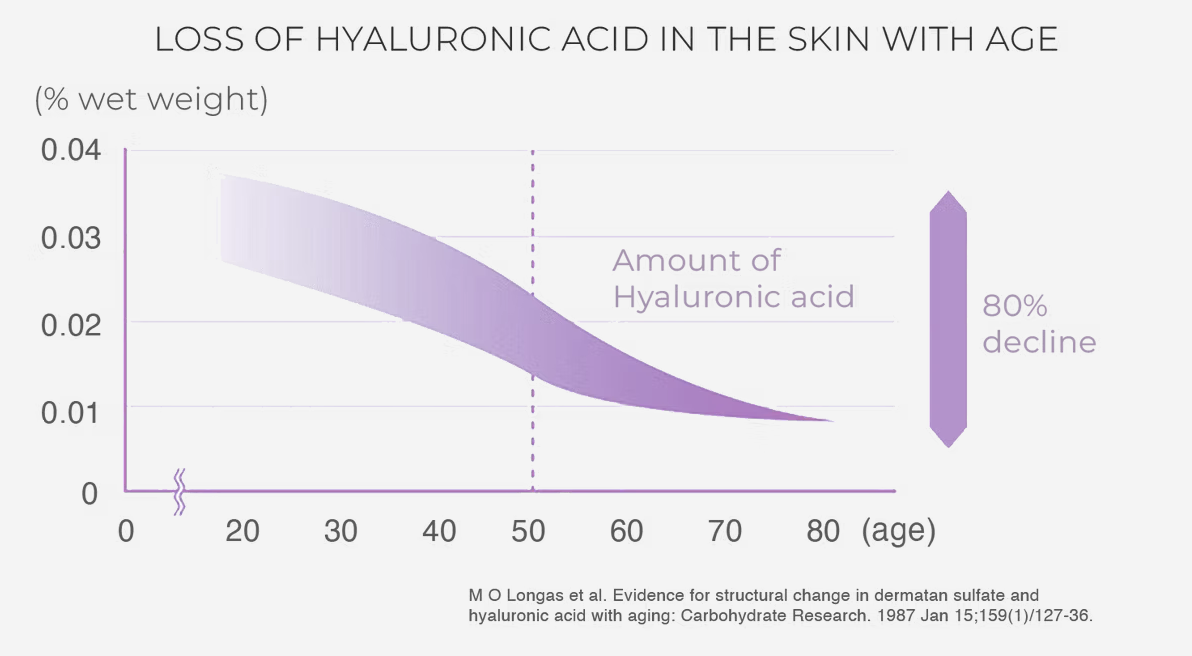
The skin loses elasticity and firmness, becomes thinner and dry, and fine lines appear on its surface. Therefore, correcting this loss of HA is an essential component of an anti-aging strategy.
A large molecule whose skin penetration is problematic
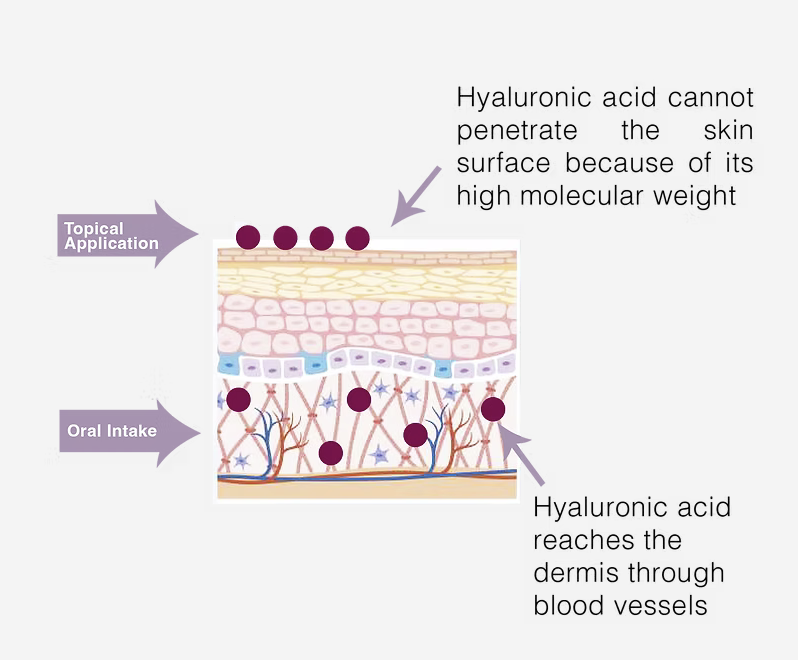
As the molecular weight of HA is relatively high, its penetration in the skin is very problematic when topically applied, and HA-based creams, lotions and serums will only moisturize the superficial layers of the skin. On the contrary, when orally administered, 90% of the ingested HA is absorbed into the body and migrate into connective tissues, such as skin (6-8). HA will then increase water in the skin and stimulates collagen, HA and proteoglycan synthesis as demonstrated in several clinical studies (9-13).
As a result, HA will provide a durable and deep skin hydration with a plumping effect.
Why NMN supplementation ?
NMN (Nicotinamide Mononucleotide) is a naturally occurring molecule found in all living cells. It serves as a direct precursor to NAD+ (Nicotinamide Adenine Dinucleotide), an essential coenzyme required for cellular energy, DNA repair, and metabolism.
By middle age, our NAD+ levels have plummeted to half that of our youth (14).Because dietary amounts are too small to significantly impact NAD+ levels, oral supplementation is crucial.
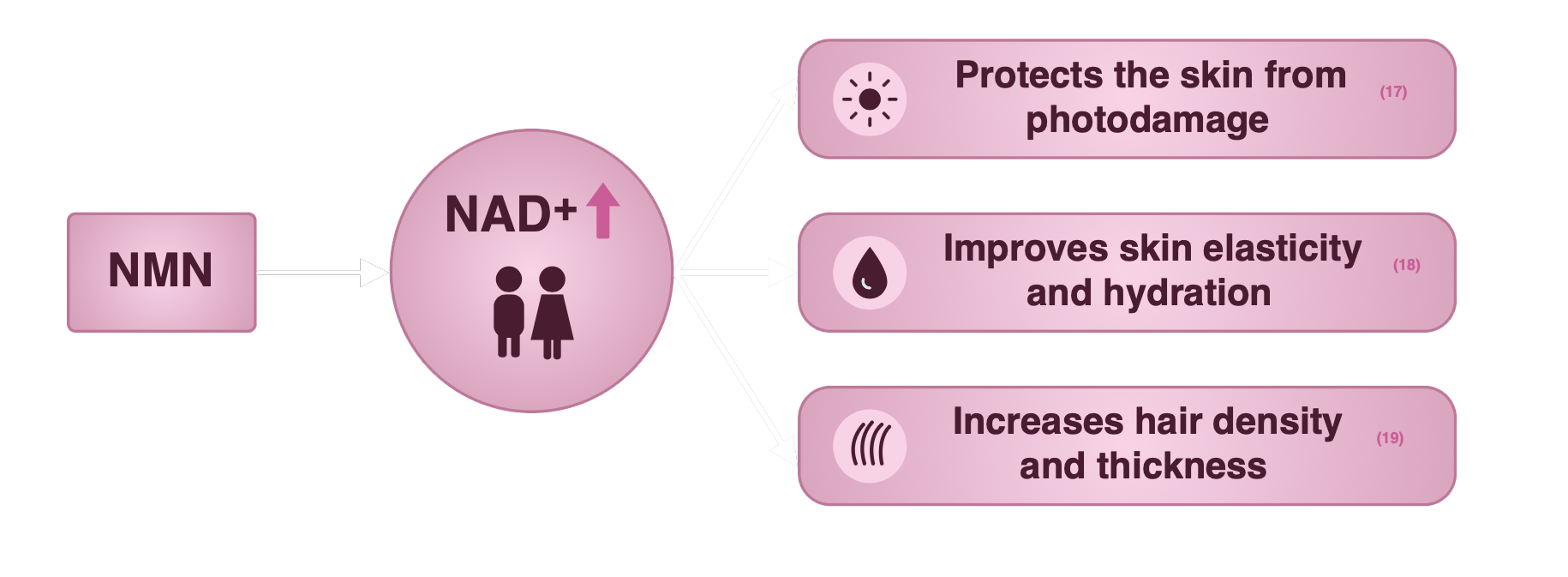
Taken orally, NMN is rapidly absorbed and converted by cells into NAD+ for immediate use (15). This increase of NAD+ levels will regulate cellular stress and DNA damage, providing a cellular repair.
-
1. Laurent TC, Fraser JR. Hyaluronan.‟FASEB J.‟1992;6:2397–2404. 2. Simpson RM, Meran S, Thomas D, Stephens P, Bowen T, Steadman R, Phillips A. Age-related changes in pericellular hyaluronan organization leads to impaired dermal fibroblast to myofibroblast differentiation. Am J Pathol. 2009;175(5):1915–1928. 3. Holmes MW, Bayliss MT, Muir H. Hyaluronic acid in human articular cartilage. Agerelated changes in content and size Biochem J.‟1988;250(2):435–441. 4. Uitto J. Understanding premature skin aging. N Engl J Med. 1997;337(20):1463–1465. 5. M O Longas, C S Russell, X Y He. Evidence for structural changes in dermatan sulfate and hyaluronic acid with aging. Carbohydr Res. 1987 Jan 15;159(1):127-36. 6. Sato T. Hyaluronic acid. JSMUFF. 2005;2(6):323–328. (in Japanese) 7. Balogh L, Polyak A, Mathe D, Kiraly R, Thuroczy J, Terez M, Janoki G, Ting Y, Bucci LR, Schauss AG. Absorption, uptake and tissue affinity of high-molecular weight hyaluronan after oral administration in rats and dogs. J Agric Food Chem.‟2008;56(22):10582–10593. 8. Laznicek M., Laznickova A., Cozikova D., Velebny V. Preclinical pharmacokinetics of radiolabelled hyaluronan. Pharmacological Reports. 2012;64(2):428–437. doi: 10.1016/S1734-1140(12)70784-3. 9. Kajimoto O, Odanaka W, Sakamoto W, Yoshida K, Takahashi T. Clinical effect of hyaluronic acid diet for Dry skin - objective evaluation with microscopic skin surface analyzer - J New Rem & Clin. 2001;50(5):548–560. (in Japanese) 10. Sato T, Sakamoto W, Odanaka W, Yoshida K, Urushibata O. Clinical effects of hyaluronic acid diet for Dry and rough skin. Aesthe Derma. 2002;12:109–120. (in Japanese) 11. Sato T, Yoshida T, Kanemitsu T, Yoshida K, Hasegawa M, Urushibata O. Clinical effects of hyaluronic acid diet for moisture content of dry skin. Aesthe Derma. 2007;17:33–39. (in Japanese) 12. Yoshida T, Kanemitsu T, Narabe O, Tobita M. Improvement of dry skin by a food containing hyaluronic acids derived from microbial fermentation. J New Rem & Clin. 2009;58(8):143–155. (in Japanese) 13. Terashita T, Shirasaka N, Kusuda M, Wakayama S. Chemical composition of lowmolecular weight hyaluronic acid from (chicken) and maintaining the moisture effect of ski by a clinical test. Memoirs of the Faculty of Agri of Kinki University. 2011;44:1–8. (in Japanese) 14.Zhu XH, et al. In vivo NAD assay revels the intracellular NAD contents and redox state in healthy human brain and their age dependences. Proc. Natl. Acad. Sci. 2015; 112:2876–2881 (2):CD003328. 15.Poljsak B. NAMPT-Mediated NAD biosynthesis as the internal timing mechanism: in NAD+ World, time Is running in its own way. Rejuvenation Res. 2018. June;21(3):210-224 16. Dickinson DA, Moellering DR, Iles KE, et al. Cytoprotection against oxidative stress and the regulation of glutathione synthesis. Biol Chem. 2003;384(4):527-537.